Corner Commercial Plots vs Standard Commercial Plots: Is the Premium Worth It?
When expanding or securing a commercial real estate portfolio in Pakistan, real estate investors inevitably face a critical crossroads. Should you pay a premium for a corner commercial plot, or opt for a standard, inline plot to keep your upfront costs low?
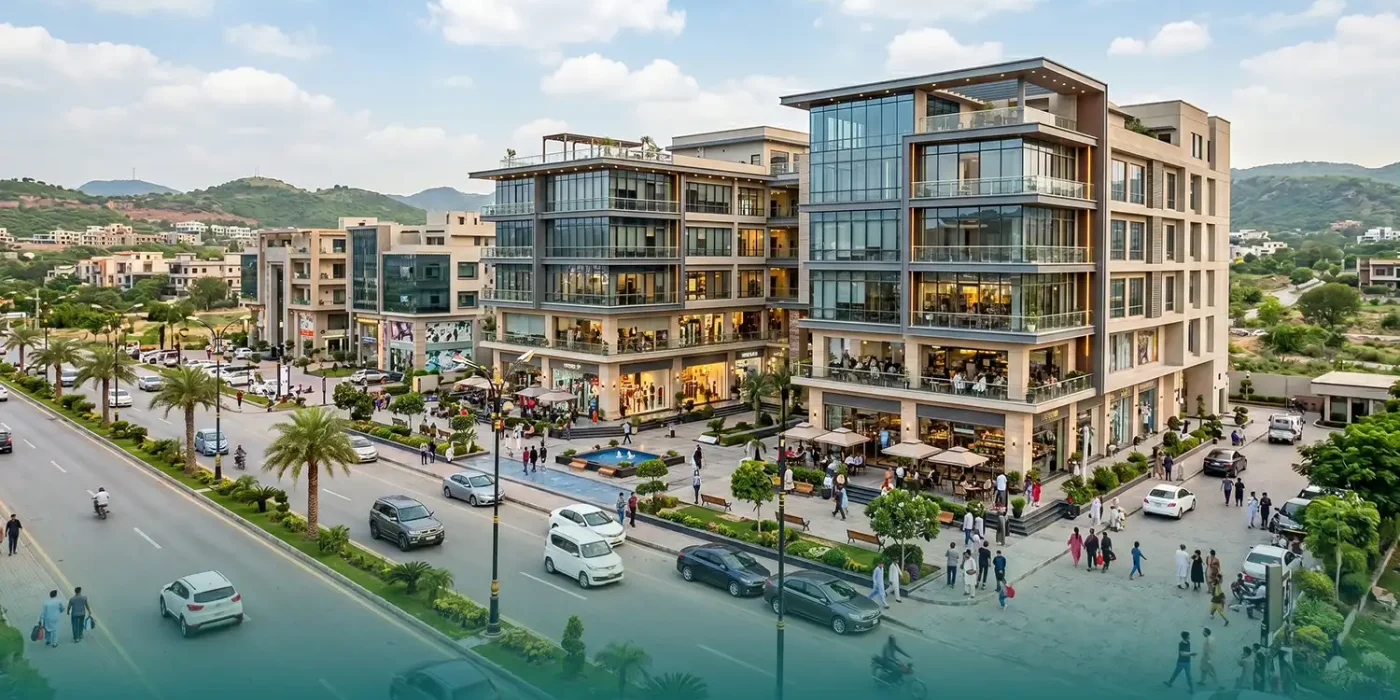
This choice is particularly pressing in premium developments like RUDN Enclave, where the newly launched High Point Commercial sector is drawing massive interest from both local and overseas Pakistani investors.
Paying more for a corner plot can feel like a gamble if you do not understand exactly how that extra cost translates into long-term profits. Conversely, saving money on a standard plot might inadvertently limit your business’s future growth, visibility, and rental yields.
This guide breaks down the core differences between corner and standard commercial plots specifically within the context of RUDN Enclave. We explore physical characteristics, pricing structures, footfall advantages, business suitability, resale liquidity, and a practical ROI framework to help you make an informed investment decision.
What Is a Corner Commercial Plot?
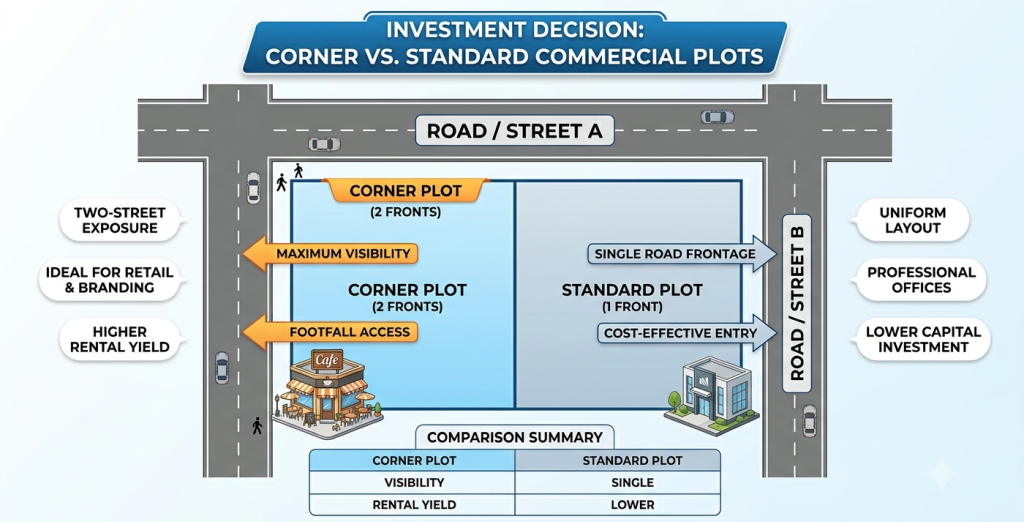
A corner commercial plot is defined as any plot situated at the intersection of two or more streets or roads within a commercial block. Unlike standard plots that are hemmed in by neighboring properties on both sides, a corner plot enjoys at least two open, road-facing sides.
Physical Characteristics
-
Dual-Frontage Architecture: Designers can utilize two distinct facades, maximizing window displays, signage, and natural light.
-
Wider Visible Façade: The linear visibility of the property is significantly greater than an inline plot of the exact same size.
-
Flexible Accessibility: Businesses can design separate entry and exit points on different roads to optimize traffic flow and logistics.
Developers across Pakistan and globally apply a pricing surcharge to corner plots because their structural availability is strictly limited by the master plan layout. In any given commercial block, standard plots form the vast majority, while corner positions are a scarce commodity.
Note for Investors: While typical master plans feature a flat price list, prime options like corners or main-boulevard-facing locations generally incur a specific category premium during booking. Always verify the current premium percentage with your authorized dealer before finalizing your down payment.
What Is a Standard Commercial Plot?
A standard commercial plot often referred to as an inline or mid-block plot is bordered by a single road or street at the front, with neighboring commercial buildings sharing its left, right, and back walls.
Typical Characteristics
-
Single-Road Exposure: All visibility, signage, and customer access are concentrated on one primary storefront.
-
Uniform Layout: Rectangular designs make architectural planning highly predictable and cost-effective.
-
Abundant Supply: These plots form the backbone of commercial sectors like High Point Commercial, offering buyers more inventory options and location choices within the block.
Standard plots are the default option as they offer a lower barrier to entry. For investors looking to build consistent rental income without stretching their initial capital, standard plots provide a predictable, stable foundation.
The Price Premium: How Much More Do Corner Plots Really Cost?
In Pakistani real estate, prime location surcharges commonly known as “category premiums” are standard practice. Developers charge extra for features that inherently add value to a property, such as being on a corner, facing a main boulevard, or sitting adjacent to a park.
Industry Benchmarks
Across major housing societies in Islamabad and Rawalpindi, a corner commercial plot typically commands a 10% to 20% premium over the base price of a standard plot in the same block. If a standard plot costs PKR 10 million, the corner equivalent will generally range between PKR 11 million and PKR 12 million.
Illustrative Pricing Breakdown for RUDN Enclave
To understand how this premium influences your payment schedule, examine this calculated model based on standard payment structures for a typical 4-Marla commercial plot:
| Plot Type | Base Price (PKR) | Premium % | Total Price (PKR) | Down Payment (20%) | Monthly Installment (48 Mos) |
| Standard 4-Marla | 9,000,000 | 0% | 9,000,000 | 1,800,000 | 112,500 |
| Corner 4-Marla | 9,000,000 | 10% | 9,900,000 | 1,980,000 | 123,750 |
| Corner 4-Marla | 9,000,000 | 15% | 10,350,000 | 2,070,000 | 129,375 |
Disclaimer: The numbers above serve as a structural example. Real-time pricing, discounts, and specific category charges must be confirmed directly through official RUDN Enclave updates.
How Premiums Are Applied
Developers apply premiums using three main methods:
-
Percentage Surcharge: A flat 10% or 15% is added directly to the total plot value, increasing both the down payment and subsequent installments proportionally.
-
Per-Marla Rate Increase: The base rate per Marla is set higher for prime inventory.
-
Lump-Sum Surcharge: A fixed category fee is charged at the time of booking or allocation.
Visibility & Footfall: The Real Case for Corner Plots
The financial justification for paying a corner premium rests entirely on one core real estate metric: conspicuous visibility.
Two-Street Exposure
A standard shop has one chance to catch the eye of a passing customer. A corner shop has two. Pedestrians and drivers approaching from multiple directions are naturally exposed to the corner building’s signage. This dual exposure minimizes the “hidden shop” problem that often plagues mid-block businesses when a commercial district becomes densely built out.
[Traffic Direction A] --->  ┌───────────┐
                            │  CORNER   │ <--- Visible from both roads
[Traffic Direction B] --->  │   SHOP    │
                            └───────────┘
Strategic Business Alignment
Certain consumer-facing business models require high visibility to survive, while others do not:
-
High-Benefit Businesses: Retail brands, flagship fast-food franchises, pharmacies, cafes, and bank branches actively compete for corner positions. For these businesses, the corner functions as passive marketing, turning passing traffic into walk-in customers.
-
Low-Benefit Businesses: Software houses, corporate back-offices, wholesale storage units, and dental clinics operating primarily on an appointment basis derive minimal value from double road exposure.
The Compounding Visibility Effect
Consider a conservative estimate. If a corner location attracts just 25% more daily visual exposure than an inline shop, that advantage compounds across weeks, months, and years. Over a decade, that translates into millions of additional impressions, directly lowering the tenant’s customer acquisition costs and driving higher sales volume.
Business Suitability: Does Your Project Actually Need a Corner Plot?
Before choosing a plot, you must determine whether your eventual tenant or your own business actually requires a corner location. High-value real estate investments yield the best returns when the physical features of the property align perfectly with its operational use.
Use this checklist to evaluate which plot type aligns with your commercial goals:
Choose a Corner Plot If:
-
Your target tenants are international fast-food chains, popular local cafes, or premium retail brands.
-
You plan to build a multi-story commercial building where a prominent corner entrance can elevate the prestige of upper-floor corporate suites.
-
You want to maximize ground-floor rental yields by splitting the space into two separate, road-facing retail booths.
-
Your exit strategy relies on high liquidity and fast resale to institutional buyers.
Choose a Standard Plot If:
-
You are working within a strict, non-negotiable initial capital budget.
-
Your intended business model relies on digital marketing, online delivery, or pre-scheduled appointments (e.g., tech startups, distribution offices, labs).
-
You want to minimize architectural design costs and build a standard, highly efficient structure.
-
You are focused entirely on long-term land holding/appreciation rather than maximizing immediate rental yield from retail footfall.
Resale & Rental Value Comparison
Understanding how standard and corner plots perform in the open market over time is essential for long-term financial planning.
Market Liquidity
Corner commercial plots inherently enjoy higher liquidity. Because they are limited in number, institutional buyers, corporate brands, and wealthy investors looking to park capital long-term usually target corner properties first. In a sluggish market, a corner plot will almost always sell faster than a standard plot in the same block, giving you an easier exit strategy.
Rental Premiums
Because a corner location can generate higher revenues for retail tenants, landlords can comfortably demand a rental premium. If standard retail space in High Point Commercial rents for PKR 150 per square foot, a corner shop can easily command PKR 180 to PKR 200 per square foot, a rental premium of 20% to 33%.
Long-Term Appreciation Trends
As a commercial sector matures, the value gap between standard and corner plots generally widens. When a society is in its early development phases, prices are driven primarily by speculation and raw land value. Once buildings go up, businesses open, and actual foot traffic arrives, the practical utility of the corner location becomes obvious, causing its market value to appreciate faster than surrounding inline options.
| Metric | Corner Plot Performance | Standard Plot Performance |
| Resale Speed (Liquidity) | High. Sells quickly due to low scarcity | Moderate. Depends on block occupancy |
| Rental Premium % | 15% to 30% higher than baseline | Base market rate |
| Long-Term Appreciation | Accelerates faster as foot traffic grows | Linear, steady growth |
Hidden Costs & Considerations Beyond Price
While the benefits of corner plots are significant, you must also account for several less obvious factors before signing your booking form.
Setbacks and Building Bylaws
Local development authorities and society management boards (including RUDN Enclave’s design committee) enforce specific building bylaws. Corner plots occasionally require larger setbacks (empty spaces left unbuilt for road safety and visibility lines) on both road-facing sides. This can slightly reduce the total buildable footprint of your ground floor compared to a standard plot where you can build edge-to-edge on the sides.
Increased Construction and Upkeep Costs
Building two exterior facades instead of one means spending more on high-quality finishings, premium glass storefronts, exterior lighting, and weather-resistant paint. Your maintenance fees and commercial property taxes can also be slightly higher depending on how the local regulatory authority assesses multi-frontage properties.
Traffic Noise and Pollution
Dual road exposure means exposure to traffic noise from two sides. If you intend to lease the upper floors for high-end corporate offices or executive apartments, you will need to invest in double-glazed windows and superior acoustic insulation to maintain a premium environment inside.
Side-by-Side Summary: Corner vs. Standard
Here is a concise, direct comparison of how these two property types stack up across primary investment metrics:
| Investment Factor | Corner Commercial Plot | Standard Commercial Plot |
| Upfront Price | Higher (Requires a 10%–20% premium) | Base price (No added location fees) |
| Visibility | Exceptional (Dual-road exposure) | Standard (Single-road exposure) |
| Footfall Potential | High (Captures traffic from two directions) | Normal (Captures single-lane traffic) |
| Rental Potential | Commands premium rental rates | Yields standard market-competitive rent |
| Resale Velocity | Faster turnaround due to high demand | Average turnaround times |
| Ideal Use Cases | Retail, F&B, showrooms, banks | Corporate offices, clinics, service centers |
| Long-Term ROI | Higher total yield if properly utilized | Stable, predictable, low-risk returns |
Real Numbers: Is the Premium Worth It? A Simple ROI Framework
To determine if a corner premium makes financial sense, look at a practical, worked example. This exercise helps clarify whether the extra upfront cash yields a genuine net profit over time.
The Scenario
Assume you are comparing a standard 4-Marla commercial plot against a corner 4-Marla plot carrying a 10% premium.
-
Standard Plot Investment: PKR 9,000,000
-
Corner Plot Investment: PKR 9,900,000 (An extra upfront cost of PKR 900,000)
Projected Rental Earnings
Once the market matures, assume the standard plot generates a steady rental income of PKR 50,000 per month (PKR 600,000 per year).
Because of its dual visibility and high-traffic position, your corner building easily secures a premium corporate or retail tenant, fetching a 20% higher rent of PKR 60,000 per month (PKR 720,000 per year).
-
Additional Annual Rental Income: PKR 120,000
Evaluating the Return
In this framework, it takes 7.5 years of active rental operations to completely neutralize the upfront premium. After year 7.5, that extra PKR 10,000 every month becomes pure profit.
More importantly, this equation doesn’t account for capital gains. When you decide to sell the asset, the corner plot’s intrinsic scarcity means you will likely recover that 10% to 20% premium and often more directly from the next buyer, making your actual net return significantly higher.
Who Should Pay the Premium and Who Shouldn’t?
The choice between these two plot types is not about finding the “perfect” property; it’s about matching the real estate to your investment profile.
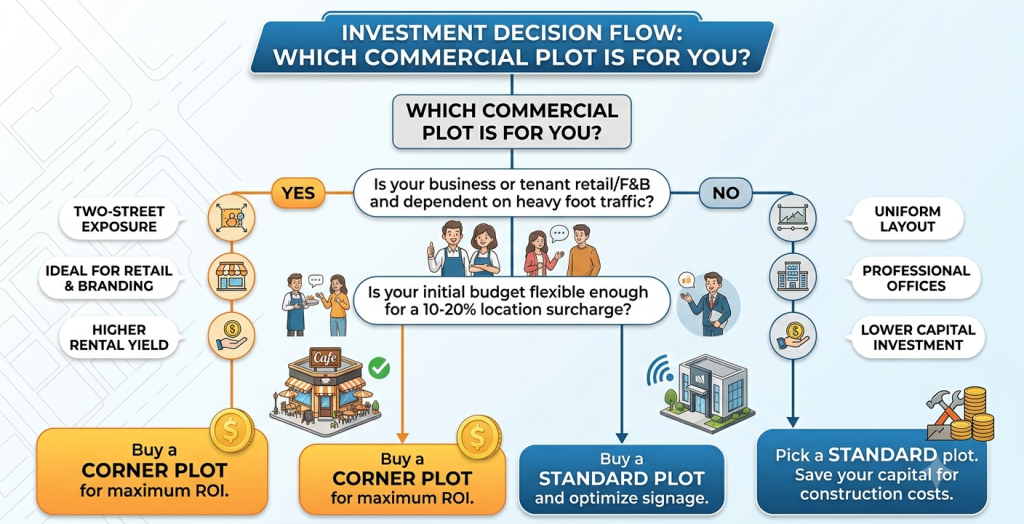
Pay the Premium If:
-
You have a flexible capital runway: You can comfortably pay the extra down payment and slightly higher installments without compromising your future building construction budget.
-
Your strategy is consumer-centric: You plan to construct a retail plaza, plaza-style food court, or flagship commercial outlet designed for consumer brands.
-
You prioritize exit speed: You like having a highly liquid asset that can be converted back to cash quickly during market peaks.
Skip the Premium If:
-
You are budget-conscious: Your primary goal is to enter the RUDN Enclave commercial market safely without overextending your finances.
-
Your business model is internal: You want to build a corporate office for your own company, a medical testing hub, or a software house where customers visit by appointment or work remotely.
-
You want maximum square footage for your money: You prefer investing your extra capital into high-end construction materials, smart building systems, or interior design rather than raw land location surcharges.
How to Book Your Commercial Plot in High Point Commercial
Securing your commercial plot in RUDN Enclave involves a straightforward, structured process managed through authorized channels.
Step 1: Verify Live Inventory and Premium Status
Contact your trusted real estate consultant or visit the official RUDN Enclave sales office to check the current master map. Confirm which corner positions are still unbooked in the High Point Commercial block and verify the exact premium percentage applicable to those specific serial numbers.
Step 2: Complete the Documentation
Prepare the necessary paperwork required for commercial bookings:
-
Two copies of the applicant’s CNIC or National Identity Card for Overseas Pakistanis (NICOP).
-
Two passport-sized photographs of the applicant.
-
One copy of the nominee/next-of-kin’s CNIC.
Step 3: Submit Payment
Pay your down payment (typically 20% of the total plot value plus any immediate category premium) via a secure pay order or bank draft made out directly to the official developer account of RUDN Enclave.
Step 4: Follow the Installment Ledger
Once your booking is processed, you will receive your official allocation file and an installment ledger. Payments are structured across a flexible multi-year plan, allowing you to manage construction cash flows smoothly.
Making the Right Move
Paying the premium for a corner commercial plot in RUDN Enclave’s High Point Commercial is highly justified if your long-term business goals or prospective tenants rely on walk-in traffic, visibility, and brand prestige. The increased footfall and higher rental yields comfortably offset the upfront surcharge over time.
However, if you are looking for a secure, cost-effective way to ride the wave of RUDN Enclave’s capital appreciation, or if your business model doesn’t depend on raw physical visibility, a standard plot provides exceptional value without unnecessary financial overhead.
Evaluate your budget, define your target tenant profile, and choose the plot type that serves your financial future best.
Ready to secure your location? Contact the RUDN Enclave sales team or your authorized real estate dealer today to check live map availability for corner and standard plots in High Point Commercial.
Frequently Asked Questions (FAQs)
Do corner commercial plots cost more in RUDN Enclave?
Yes. Following standard real estate practices in Pakistan, corner plots carry a category premium (typically between 10% and 20%) because they offer dual road frontage and are limited in number on the master plan.
Is corner plot always a better investment than a standard plot?
Not necessarily. A corner plot is a better investment if you or your tenants run a retail business, eatery, or brand showroom that requires high visibility. If you need space for an office, clinic, or service center, a standard plot offers similar functional utility at a significantly lower price point.
Do corner plots resell faster than standard commercial plots?
Yes. Corner plots enjoy higher market liquidity. Because corporations, franchises, and premium brands actively seek out corner locations for maximum visibility, these plots face higher demand and sell faster when listed on the secondary market.
What businesses benefit most from a corner commercial plot?
Retail stores, fast-food chains, coffee shops, pharmacies, banks, apparel brands, and supermarkets benefit most because the dual road exposure acts as continuous, passive outdoor marketing to passing traffic.
Are there additional construction restrictions on corner plots?
Depending on society bylaws, corner plots may require specific building setbacks on both road-facing sides to ensure open traffic view-lines. This can sometimes result in a slightly modified buildable footprint compared to standard, inline plots. Always check the official building regulations before designing your layout.