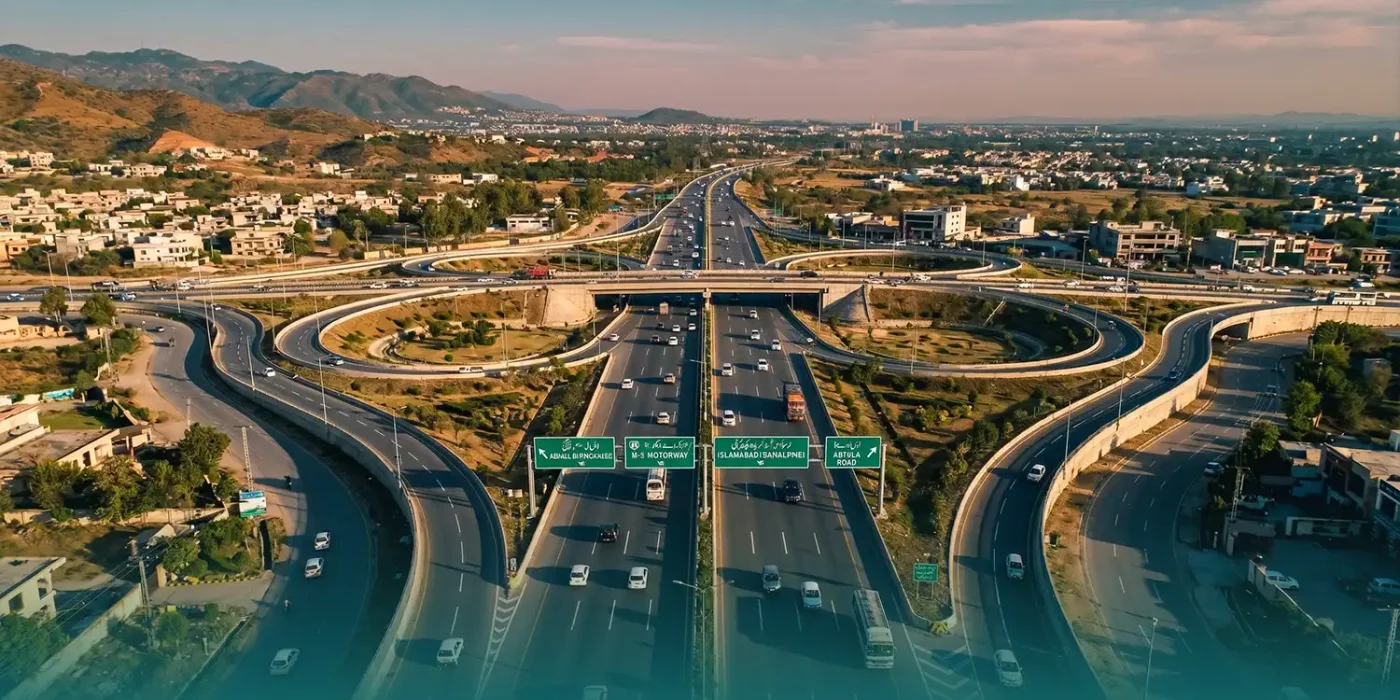
The Rawalpindi Ring Road is a 38.6-kilometre, six-lane controlled-access expressway running from GT Road near Rawat to the M-2 Motorway near Thalian. Designed for speeds of up to 120 km/h, the entire corridor is access-controlled so you cannot enter or exit at just any point. You get on and off at five designated interchanges, and where those interchanges sit matters enormously for commuters, residents, and investors alike.
Here is a full breakdown of each one: where it is, what roads it connects, what is nearby, and what its current status is as of June 2026.
Banth Interchange | GT Road (N-5), Rawat
Position on the corridor: Eastern starting point of the Ring Road
The Banth interchange is where the Ring Road Rawalpindi begins, sitting on the Grand Trunk Road (N-5) near Rawat. For the vast majority of people coming from central Rawalpindi, this is the entry point. It pulls traffic off GT Road before it reaches the congested stretches of Raja Bazar, Liaquat Bagh, and Committee Chowk and redirects it onto the Ring Road corridor heading west toward the motorway.
Rawat itself is a busy commercial and transport junction. An estimated 80,000 vehicles per day currently use GT Road to enter Rawalpindi. Once the Rawalpindi Ring Road is operational, a significant portion of that traffic, particularly intercity and heavy vehicles, is expected to divert onto this corridor rather than pass through the city. The Banth interchange is also the access point for residents and investors in areas close to the Rawat end of the corridor.
The interchange has been reported complete as of June 2026, along with the Rawalpindi Ring Road’s main carriageway, and is the designated opening point for the initial phase of public traffic.
Chak Beli Khan Interchange | Chak Beli Khan Road (Maira Mohra)
Position on the corridor: Second interchange, mid-eastern section
The second interchange sits at Chak Beli Khan Road, at a location locally referred to as Maira Mohra. Chak Beli Khan is not a small locality, it is one of the largest towns in Rawalpindi District by population and serves as the commercial hub for more than 110 surrounding villages in the Potohar region. It is on the Potohar Plateau near the Soan River and Jabba River, and its marketplace has historically served as a trade centre for a wide belt of rural communities in the area.
Before the Ring Road, the only practical access to this belt from Rawalpindi’s main road network was through local roads that ran through or around the plateau. The Chak Beli Khan interchange gives this entire zone a direct connection to an access-controlled, high-speed corridor for the first time. For Rawalpindi’s agricultural and goods-transport traffic coming out of the Potohar interior, this is likely to be the most practically significant interchange of the five.
The interchange is reported complete as of June 2026.
Adiala Road Interchange | Khasala
Position on the corridor: Third interchange, mid-corridor
The Adiala Road interchange, built at a location known as Khasala, is the mid-point of the Ring Road and arguably the one with the densest residential and real estate activity around it. It connects the Ring Road to Adiala Road, which runs south from Rawalpindi toward Adiala Jail, Jarrar Camp, and the Potohar belt beyond.
The immediate surroundings include RUDN Enclave, whose Executive Block entrance is located directly at this interchange making it one of the rare cases where a housing society’s boundary and a Ring Road interchange are the same physical point.
A 2-kilometre section of service road runs alongside the main carriageway near this interchange, serving the Nawaz Sharif Flyover that connects Kutchery Chowk to the Ring Road via Adiala Road. Punjab Chief Minister Maryam Nawaz inaugurated this flyover in July 2025 and stated that it would cut the Rawalpindi-to-Chakri travel time by approximately one hour.
The Adiala interchange is reported complete as of June 2026.
Chakri Road Interchange | Kolian Parrh / Maira Shareef
Position on the corridor: Fourth interchange, mid-western section
The Chakri interchange is located near Maira Shareef on Chakri Road and is the Ring Road’s connection to the Chakri corridor, a stretch that has seen the most concentrated housing society development of anywhere along the route.
From this interchange, the New Islamabad International Airport is approximately 20 minutes by road, and the Chakri M-2 Toll Plaza is about 13 minutes. The interchange is also referred to as Kolian Parrh in some project documentation.
In societies near Chakri road interchange, the Overseas Block of RUDN Enclave has a secondary entrance point near it, giving it access from both the Adiala and Chakri interchanges.
In terms of sheer volume of real estate marketing activity, the Chakri interchange has generated more investor attention than any other point on the corridor. Its long-term value depends on development progress, NOC status, and actual possession timelines for each individual project.
The interchange is reported complete as of June 2026.
Thalian Interchange | M-2 Motorway (Phase II)
Position on the corridor: Western terminus, connecting to M-2 Motorway
The Thalian interchange is where the Rawalpindi Ring Road meets the Lahore–Islamabad Motorway (M-2), and it is the only one of the five that is not yet complete at the time of the Ring Road’s initial opening.
The full Thalian interchange has been deferred to Phase II of the project. A separate PC-1 of Rs 4.8 billion has been approved for it, and construction will be handled by the National Highway Authority (NHA) rather than the Frontier Works Organisation. In the interim, the Punjab government has decided to connect the Ring Road to the M-2 through a widened two-way carriageway arrangement involving approximately 23.23 kilometres of additional lanes. This temporary setup is designed to handle over 18,000 vehicles per day merging onto the motorway from the Ring Road.
Why the Interchange You’re Near Matters
On a controlled-access expressway, distance from an interchange is not just a travel convenience, it determines your practical relationship with the road. A project that is 5 kilometres from an interchange with no direct slip road has a fundamentally different access story from one whose boundary wall sits at the interchange itself. Before making any buying or commuting decision based on proximity to the Rawalpindi Ring Road, check which specific interchange serves your area, whether that interchange is complete, and what the connecting road looks like between the interchange and your destination.
Four of the five interchanges, Banth, Chak Beli Khan, Adiala, and Chakri are confirmed complete as of June 2026. The Thalian interchange remains under a separately budgeted Phase II with its own timeline. The main Ring Road carriageway is fully carpeted and the corridor is expected to open for public traffic from the Banth interchange in end-June 2026.