The Rawalpindi Ring Road is 90% complete and days away from opening. If you own a plot somewhere along the Adiala Road, Chakri Road, or GT Road corridor, you have probably already seen prices move. The question most plot holders and prospective buyers are asking right now about prices is how much will it increase, and whether the best of the appreciation has already happened.
What the data and precedent actually says, broken down by interchange, location and what drives value and what does not.
Difference in Appreciation Potential
The single biggest mistake in Rawalpindi Ring Road property analysis is treating the corridor as a uniform price event. It is not. A controlled-access expressway only adds value to properties that have practical, direct access to it. In the case of Rawalpindi Ring Road, access means being adjacent to or near one of five interchanges, Banth, Chak Beli Khan, Adyala Road, Chakri Road, and Thalian. A plot marketed as near the Ring Road that sits 8 kilometres from the nearest interchange on an unmaintained secondary road does not get the same benefit as a plot whose boundary touches an interchange. The gap between those two situations can be the difference between real appreciation and vague claims.
What Has Already Happened to Prices
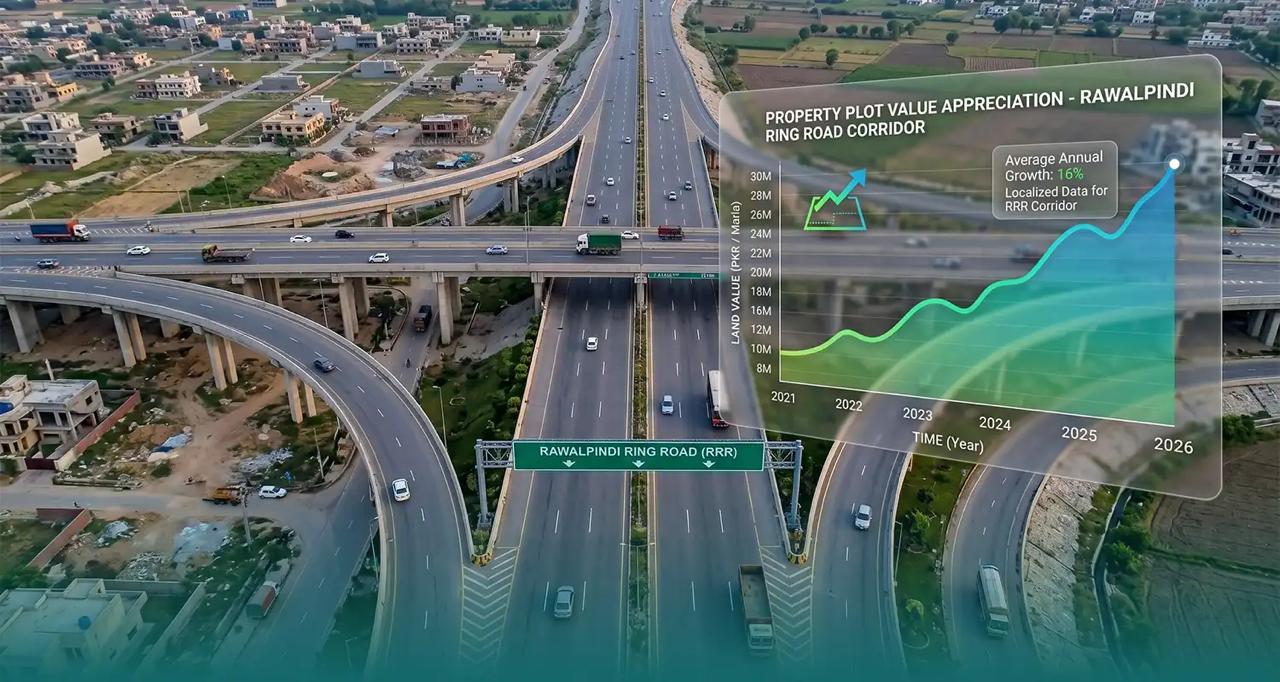
Price appreciation along the Ring Road Rawalpindi corridor did not wait for the road to open. It followed the construction announcement and picked up pace as each completion milestone was reported. This is consistent with how major infrastructure projects affect land prices in Pakistan, the gap between announcement and opening is often where the largest percentage gains occur, because early buyers are pricing in future access rather than paying for current access.
By the time a road actually opens, the contribution of access is already in the price. This has been true of the Rawalpindi Ring Road. Land prices along Adyala Road and Chakri Road have risen materially since 2022 when construction formally began, and have risen again with each major progress update.
The Lahore Ring Road Comparison
Lahore Ring Road is a comparable controlled-access corridor in the same province, with a longer operational history. The numbers from Lahore are the most reliable benchmark available for estimating what the Rawalpindi Ring Road will do to nearby property.
Properties along the Lahore Ring Road corridor have seen residential prices rise by an average of 20–30% over five years. For societies with direct interchange access, appreciation has ranged between 40–60% depending on the project, its development stage, and the specific interchange it sits on. These figures span multiple years and reflect the combined effect of improved access, follow-on commercial development, and increased buyer confidence.
Translating this directly to Rawalpindi requires caution. The Lahore and Rawalpindi markets have different price bases, different buyer profiles, and different levels of existing infrastructure. But the directional principle is solid. Plots with direct interchange access in a Ring Road corridor appreciate more than the surrounding average, and appreciation tends to cluster most visibly in the two to three years following operational opening.
Interchange Connectivity
Banth Interchange
The eastern entry point of the Rawalpindi Ring Road connects to GT Road at Rawat. Its value impact is primarily commuter-driven. Residents and buyers who currently navigate GT Road congestion gain a faster, signal-free alternative route to the motorway and to the Chakri/Adiala belt. Commercial land near the interchange itself is likely to see the sharpest near-term movement as transport-related businesses, filling stations, logistics facilities, seek interchange-adjacent locations.
Chak Beli Khan Interchange
This interchange serves a predominantly agricultural and rural belt connecting over 110 villages in the Potohar region. The value impact here is less about housing society plots and more about agricultural and peri-urban land, which becomes commercially viable as access improves.
Adiala Road Interchange
This is the single most impactful interchange for residential plot values in 2026. RUDN Enclave’s Executive Block entrance is directly linked to Adyala interchange. The Ring Road does not pass close to RUDN Enclave, it passes through it. The practical effect is that RUDN Enclave residents will have direct, signal-free access to GT Road in one direction and the M-2 Motorway in the other.
RUDN Enclave also has a secondary access point near the Chakri Road interchange via its Overseas Block, giving it a footprint across both interchange clusters, a positioning that very few societies along the corridor share.
Chakri Road Interchange
The Chakri interchange anchors the western cluster of the Ring Road Rawalpindi corridor. The key value driver here is not just the Ring Road itself but the airport access it enables. The New Islamabad International Airport is approximately 13–15 minutes from the Chakri interchange, and the combination of motorway and airport proximity is what underpins the long-term commercial case for this belt. Plot values in this corridor have already moved significantly and will continue to be supported by airport-side activity.
Thalian Interchange
Thalian sits at the motorway end of the Ring Road and is currently a Phase II project with its own Rs 4.8 billion PC-1 under NHA execution. Plot values near Thalian reflect both the existing motorway proximity premium and the anticipated Rawalpindi Ring Road connectivity. Post-opening appreciation here will be partial until Phase II is complete. Full motorway integration is the event that converts proximity into practical, daily-use access.
The Factors That Drive Value Beyond Just Proximity
NOC and legal status
A plot in a society without RDA approval, PHATA layout plan, or CDA sanction does not appreciate the same way as a legally verified plot. The Ring Road improves access, it does not regularise unapproved land. Several societies in the Chakri and Adiala belts have disputed or incomplete approval status. Verify yours independently through RDA or CDA/PHATA before pricing in the Rawalpindi Ring Road route.
Possession and development status
Plots in societies with actual possession, developed roads, utility connections, and inhabitable conditions have different prices than plots in early-development or file-stage projects in the same geographic area. The Ring Road widens this gap rather than closing it for buyers willing to move in and want move-in-ready access.
The industrial estate timeline
If the Punjab Assembly passes the enabling legislation for the PIEDMC industrial estate along the Rawalpindi Ring Road corridor and land acquisition begins quickly, land near the Banth and Adyala interchanges will face a new demand driver from industrialists and logistics operators. RCCI’s Group Leader specifically warned that government acquisition costs would rise once the road opened. The same dynamic applies to private land nearby.
What the Opening Itself Changes
The transition from under construction to operational does three specific things to the property market along the corridor.
First, it removes uncertainty. A significant share of buyers who have been waiting to see whether the road actually opens will enter the market in the months following inauguration. This generates a short-term increase in transaction volumes, which can push prices higher even when the fundamental access improvement was already priced in.
Second, it triggers commercial follow-on development. Petrol stations, marts, fast food outlets, courier and logistics depots, and other road-adjacent commercial activity begin clustering near interchanges within twelve to eighteen months of opening. This commercial activity raises the attractiveness and market rates of nearby residential land.
Third, it makes the Lahore Ring Road comparison concrete rather than hypothetical. Buyers who were uncertain whether the Rawalpindi Ring Road would deliver the same kind of access improvement as Lahore’s now have the evidence in front of them. This typically increases buyer confidence in the corridor and draws in a new segment of investors who were waiting for confirmed delivery.
Conclusion
If your plot is directly adjacent to one of the four operational interchanges particularly Adiala Road or Chakri Road, a meaningful share of the Ring Road potential is likely already in your price. The post-opening phase will sustain and consolidate that value, with the magnitude depending on how quickly the industrial estate, commercial corridor, and transport terminal relocations materialise.
If your plot is more loosely near the Ring Road Rawalpindi, within the corridor but not at an interchange,the opening matters but the value impact will be slower, more gradual, and more dependent on the overall development of the 500-metre strip on either side of the road.
If your plot is in a society whose NOC or possession status is incomplete, the Ring Road does not solve that problem. It makes the location more desirable, it does not make the title more secure. The road itself is almost there. What happens in the six months after inauguration will be the data worth watching.